Blog
Insights on agentic and voice AI.
The New Capacity Layer for Organizations
For many years, an organization’s capacity was measured through indicators such as employee numbers, operating hours, service channels and transaction volumes. As demand increased, teams expanded. When a new channel was introduced, new operations were established. When service hours were extended, shifts were reorganized. Digital employees are changing this equation. Today, organizational capacity is determined
The New Priority of the Agentic Age: Trust, Not Capability
There has been a clear shift in enterprise AI conversations over the past year. No one is asking, “What is a digital worker?” anymore; everyone is asking, “What can I delegate to a digital worker, and to what extent?” As digital workers move beyond demo environments and become embedded in operations, the central issue is
The New Identity Card of Artificial Intelligence
Artificial intelligence no longer just answers questions. It connects to enterprise systems, accesses data, initiates transactions, and supports employees in decision-making processes. In this new era, companies need to focus not only on the technology itself, but also on the identity, authority, and scope of responsibility of digital employees. On a Monday morning, a customer
Not the Smartest Digital Employee, but the Most Adaptable System
Organizations often focus on individual capabilities when investing in digital employees: better comprehension, more accurate decision-making, and faster task completion. However, as the number of digital employees increases, the real issue is no longer simply how successful each one is individually, but how effectively they work together within the same process. When task allocation, context
The Productivity Paradox in Artificial Intelligence: Investment Is Increasing, but Where Is Value Being Created?
Every month in our newsletter, we share our observations on artificial intelligence, along with the signals we receive from the field. Last month, we touched on the research by Google and Ipsos: two-thirds of the global population now say they use an artificial intelligence tool. The conversations we had with different age groups during the
Every Conversation Is an Insight
For years, contact centers have carried the authentic voice of the customer. With GenAI, that voice is no longer just being heard; it is being interpreted, prioritized, and integrated into decision-making processes. At CBOT, we approach this transformation not from the perspective of “AI replacing humans,” but as an intelligence layer that empowers agents and
The World Has Updated Its Expectations. Have You Updated Yours?
A Global Inflection Point in AI Adoption A seismic shift has occurred in global artificial intelligence adoption. In 2023, people were exploring the technology out of curiosity; by 2024, they began to see its practical benefits; and by 2025, AI had become an integral part of daily life and workflows. Google and Ipsos’s third annual
Why can’t digital employees be managed only as an IT project?
Digital employee strategy now opens in many organizations as a technology discussion first. That instinct is understandable. The first decisions are usually about model choice, integrations, data access, and security. But once digital employees start entering real processes, the issue changes quickly. It stops being only a technical architecture question and becomes a question of
Why are digital employees becoming not just a new technology, but a new business model question for enterprises in 2026?
Digital employees are no longer just a new technology headline for large enterprises. They are now part of a direct business model discussion. The real question is which processes these structures take responsibility for and how that impact is measured. At CBOT, the pattern we have seen in recent years is clear. Institutions first evaluate
Beyond Efficiency: The Real Game Begins
The focus of AI investments is shifting rapidly. In the initial phase, the priority for organizations was to accelerate processes, reduce costs, and increase operational efficiency. Today, however, a more critical question is on the agenda of executive teams: Is the efficiency gained through AI being transformed into new business value and competitive advantage? In
How Do Artificial Intelligence Projects Turn into Sustainable Business Value?
The focus in AI projects is gradually shifting. While model performance, tool selection, and technical capabilities were more central to the agenda at first, today organizations are increasingly asking a different question: Are these initiatives truly becoming embedded in operations and generating sustainable business value? Gartner’s strategic planning guide for R&D leaders also makes this
Generative AI Reality Check: Expectation and Reality
When we first put generative AI on the agenda, the same sentence was circulating at most tables: “Let’s do something—so competitors don’t outrun us.” That instinct isn’t bad; it’s even healthy. The problem is this: once we start running, we realize the track isn’t asphalt—it’s a construction site. Pilots launch, demos get applause, but business
Not the Model, but Sovereignty: The New Line of Division for Artificial Intelligence in Banking
Not the Model, but a Matter of Sovereignty For the past two years, conversations about generative AI have been driven by sheer horsepower: faster responses, better accuracy, larger context windows… Banking, however, quietly shifted this debate onto a different plane. Because in a bank, data is not an output; it is a legal responsibility. Customer
I Was Against It at First”: How to Overcome Digital Employee Resistance?
You still hear this sentence in meetings: “I was against it at first…” The follow-up usually goes something like: “But is it right to hand this over to a digital employee?” This line should be read less as an objection and more as an organizational reflex. Because organizations now see GenAI’s potential; they experiment, run
How to Generate Real Business Value with Digital Workers?
Over the past two years, the agenda around generative AI has become clearer. Today, concepts like “agent” and “digital worker” are no longer just buzzwords; the conversation has shifted to how these technologies can be embedded into organizational operations, how they can be scaled, and most importantly, how they can be turned into measurable business
Do Digital Workers Belong on the Payroll?
Position Definition Is Changing Until now, we matched positions with people. If there was a task, there was a title. If there was a title, there was a person. Digital Workers are changing this equation. Today, in many organizations: Digital Workers that generate pricing proposalsDigital Workers that prioritize customer requestsDigital Workers that scan for operational
How AI Priorities Changed in Financial Institutions in 2025?
Artificial intelligence in the finance sector was discussed under similar themes for a long time. It was mostly confined to customer service; playing a supportive but limited role in simple question-and-answer scenarios. This approach was beneficial to a certain extent but did not create lasting transformation in the field. 2025 became the year this cycle
Human and AI Collaboration in the Business World
When we talk about “productivity” in the business world, the first thing that still comes to mind is doing more work in less time. But we believe the picture is now much bigger than that. Real productivity means making better decisions, reducing errors, delivering more value to the customer—and doing it all without excluding the
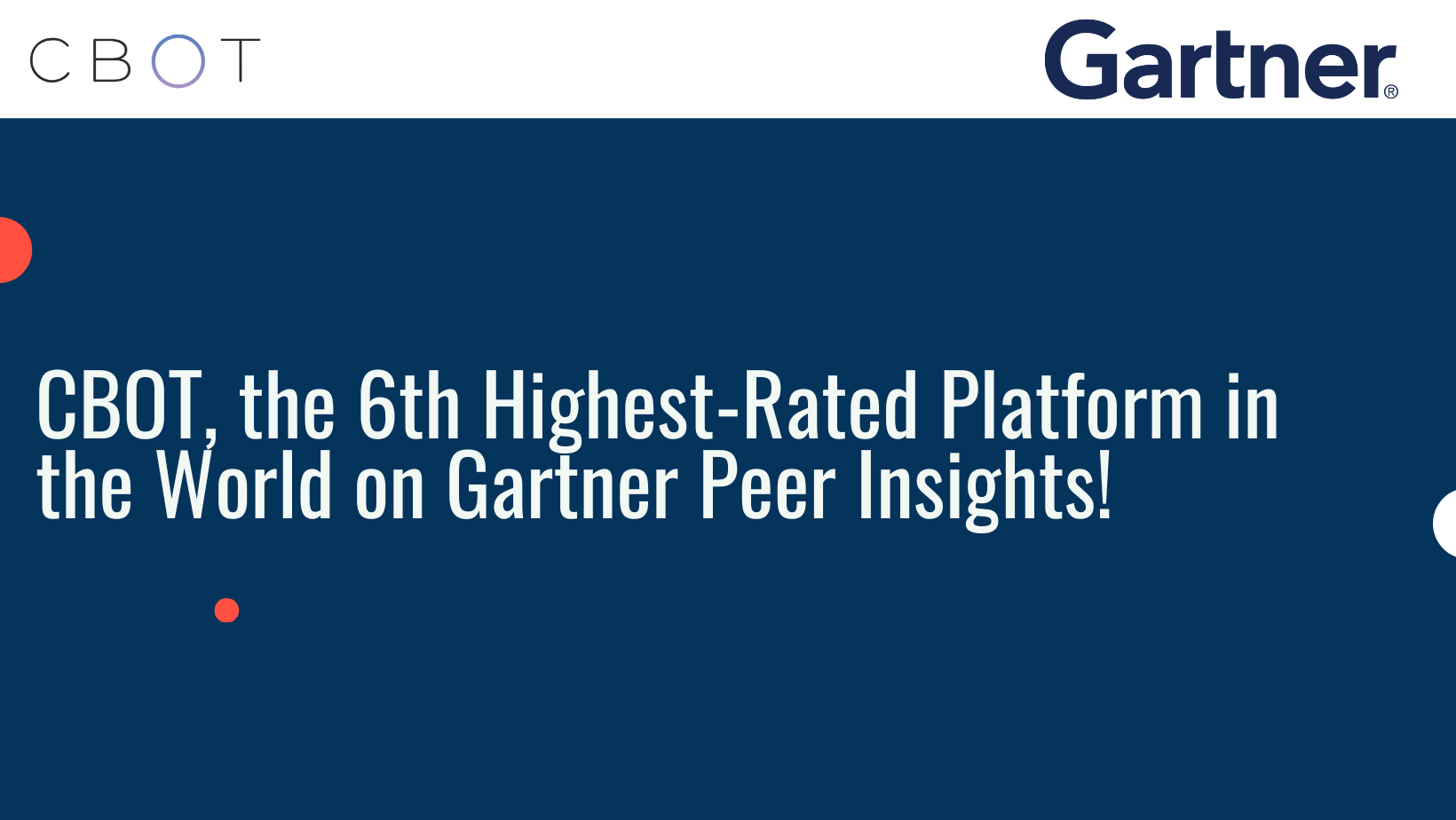
CBOT, the 6th Highest-Rated Platform in the World on Gartner Peer Insights!
A year ago, we ranked 11th. Today, we’re 6th. As we approach 2026, we at CBOT are proud to have reached a major global milestone. In the Gartner Peer Insights Voice AI category, we have risen to 6th place among 50 platforms worldwide, with an average rating of 4.7 from a high volume of user
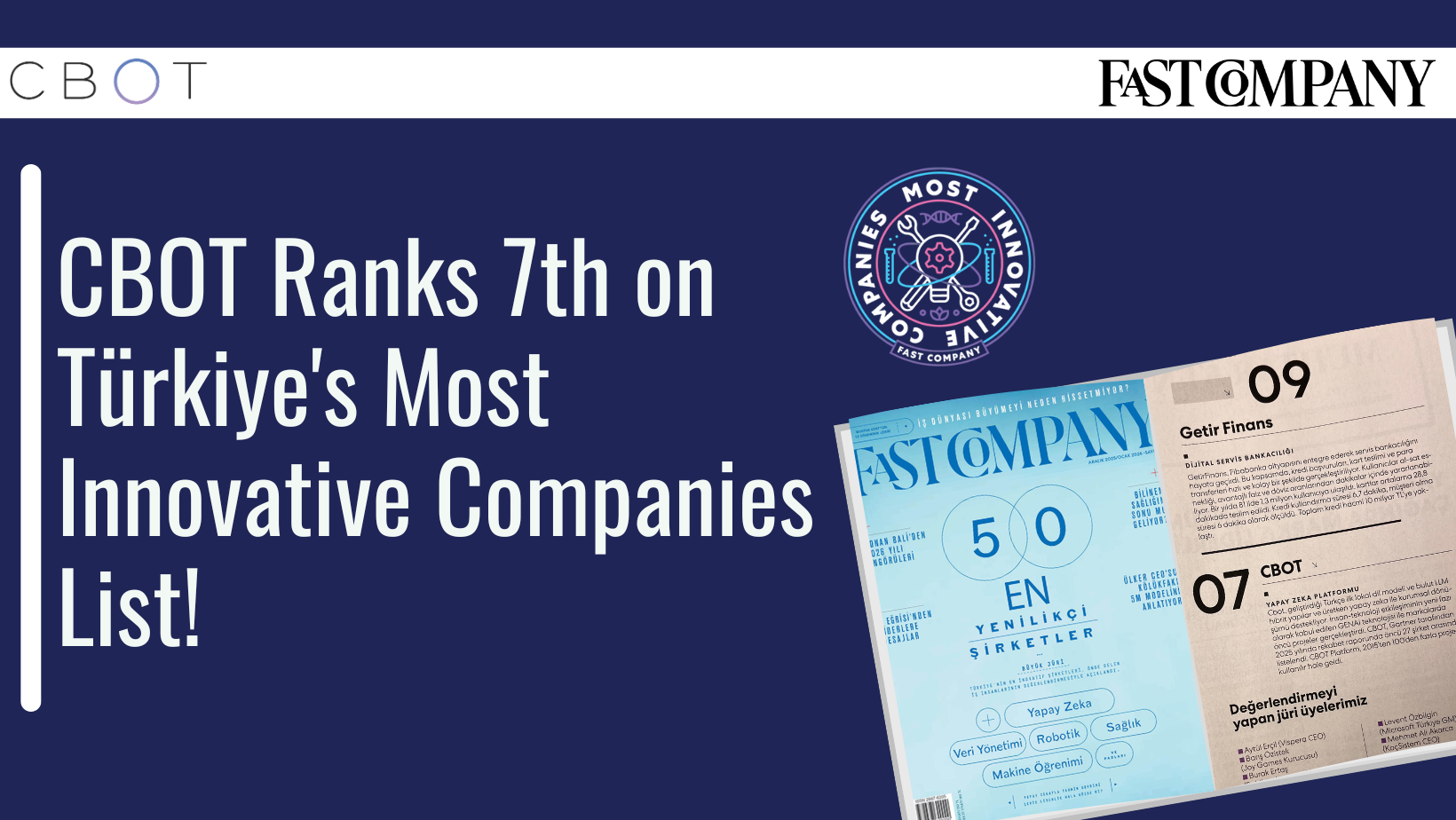
CBOT Ranked 7th Among Turkey’s Most Innovative Companies!
True innovation is not just about producing technology, but about transforming it into real business solutions and having the ability to reinvent oneself amid changing market conditions. With this vision, CBOT has advanced to the 7th position in Fast Company Türkiye’s prestigious global “Top 50 Most Innovative Companies” list for 2025, elevating our place among