You Say "Excellent." What Do Your Customers Say?
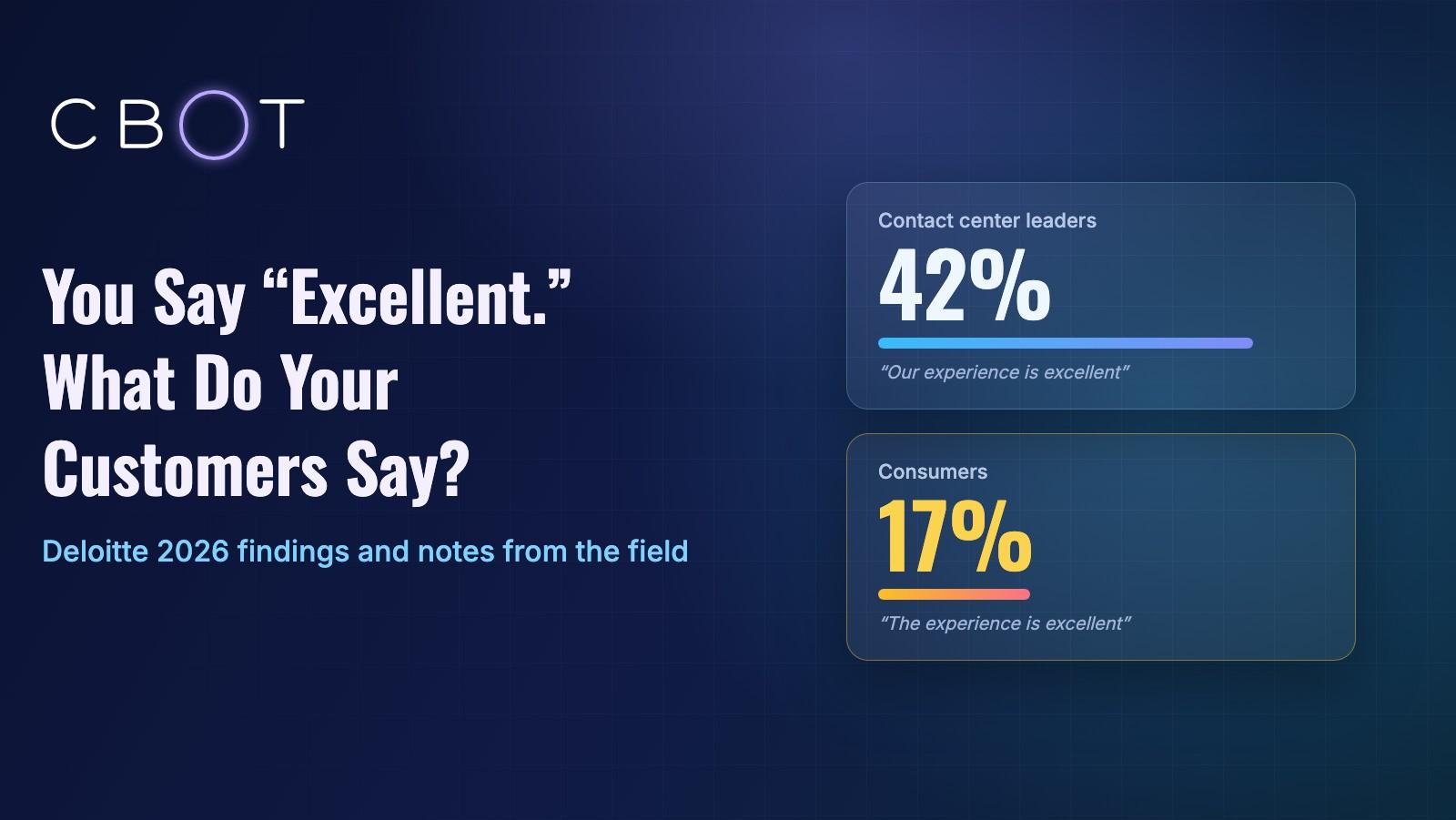
42 percent of contact center leaders rate their customer experience as excellent; among consumers, it is 17 percent. Where does AI really make a difference in customer service? Deloitte's 2026 findings.
For a long time, the conversation about AI in customer service centered on one question: Can we respond faster? Today, that question alone is not enough. Customers expect more than a quick reply. They want their needs understood, their requests resolved and, where possible, their problems solved before they even arise.
Deloitte Digital's 2026 Global Contact Center Survey, conducted with 720 contact center leaders and 3,000 consumers, puts this shift into numbers. 42 percent of contact center leaders rate the customer experience they deliver as excellent; among consumers, the figure is just 17 percent. According to the same survey, contact centers with high AI maturity report 85 percent higher profitability than less mature organizations.
42%
Contact center leadersRate the customer experience they deliver as excellent.
17%
ConsumersRate the experience they receive as excellent.
The message is clear: the difference does not come from having AI. It comes from embedding it properly into customer service. This picture also matches what we discussed in our May issue: organizations have moved from saying "We have a bot" to asking "How useful is our bot?" Deloitte's data now answers that question from the customer's point of view.
At CBOT, we see AI in customer service not just as an automation layer that answers calls, but as digital employees that understand the request, work with the organization's systems and get the job done. In this article, we look at where AI really makes a difference in customer service, combining Deloitte's 2026 findings with our own experience in the field.
Enjoy the read.
The Point Is Not a "Fast Reply" but the "Right Outcome"
When organizations discuss customer service performance, two sentences usually come one after the other: "Our response times are down" and "But customer satisfaction has not risen at the same pace." The Deloitte report shows the source of this contradiction clearly: organizations see a good picture in their own metrics, while the customer on the other end of the line has a different experience.
This is exactly where organizations with high AI maturity stand apart. They are 69 percent more likely to rate their customer experience as good or excellent, and 76 percent more likely to report a lower cost per contact.
These figures should not be read as a promise that every organization investing in AI will get the same result. The report shows a divergence, not a guarantee: the divergence between organizations that add AI on top of the existing setup and those that build it into their operations. Value does not come from the number of calls handled automatically. It comes from how quickly and accurately the request is resolved, and how easily the agent can reach the right information. This is the customer service version of the productivity paradox we discussed in our June issue.
There is one more figure in the report worth noting: organizations with high AI maturity are 60 percent more likely to rate their employee experience as good or excellent. This shows that customer experience and agent experience cannot be separated. When the load of repetitive requests drops, when customer information reaches the agent ready to use and when the conversation is handed over with its context, agents do their job better. That is often where the difference the customer feels comes from.
- Profitability
- Customer experience
- Cost per contact
- Employee experience
Where Does the Perception Gap Come From?
At first glance, the gap between 42 percent and 17 percent may look like a communication problem. What we see in the field is more structural.
For years, contact centers have been managed with metrics designed to measure their own efficiency: average handle time, answer rate, wait time and the share of requests resolved by automation. All of these metrics give accurate information about the organization's operations. But none of them alone tells you whether the customer's problem was solved.
A short call does not necessarily mean the customer's problem was solved; the customer may simply have given up. A request "handled" by a virtual assistant may have ended with the customer calling again a few hours later about the same issue. A line with low wait times may be transferring the customer to three different departments and making them explain the issue from scratch each time. Each of these calls looks successful in the organization's report, yet in the customer's memory they add up to a single bad experience.
The company's report
Short call, request handledLow handle time, call answered, short wait.
The customer's experience
Gave up, called againExplained the issue three times and it is still unresolved.
That is why measuring the success of AI projects in customer service by automation rate alone can be misleading. A more meaningful question is this: In how many steps, across how many channel switches and after explaining the issue how many times did the customer get their request resolved? What often sets organizations with high AI maturity apart is that they have started asking this question.
Customers Now Expect You to See the Problem Before They Do
One of the clearest messages of the survey is the expectation of proactive service. 77 percent of consumers expect companies to spot potential issues in advance and reach out to them; only 39 percent say they actually experience this. In other words, customer service needs to move from a model that "handles incoming requests" to one that "reaches out at the right time."
77%
Expect itConsumers expect companies to spot potential issues early and reach out first.
39%
Experience itThe share of consumers who say they actually get this.
Reminding a customer whose payment date is approaching, sharing renewal options for an expiring policy in time or reporting a disruption before the customer notices it are the most concrete examples of this shift. In the field, we see proactive communication becoming one of the most concrete use cases in high-volume industries such as banking and insurance, improving the customer experience while reducing the load on the contact center. TAHSİLDAR, which we introduced last month, is how this approach works in practice: reaching the customer at the right time and in the right tone, without waiting for them to call.
Proactive communication, however, does not mean sending more messages. A call at the wrong time or a reminder sent without knowing the customer's situation can damage the experience rather than improve it. For proactive service to work, customer history, transaction data and channel preference need to be considered together. Whether to reach the customer by phone, WhatsApp or SMS, what time to call and what happens when the customer says "this is not a good time" are decisions that need to be designed from the start.
Proactive communication also affects inbound call volume. When customers notice a problem before the organization does, their first reflex is to call the contact center. When the organization shares the same information at the right time, a significant share of those calls never happens. Proactive service thus improves the customer experience while easing the load on operations. There are not many areas in customer service where both gains can be achieved at the same time.
Agentic AI: From Systems That Answer to Systems That Get the Job Done
According to Deloitte's survey, 35 percent of contact centers already use Agentic AI, and 45 percent plan to start using it this year. This shows that digital employees are no longer an experimental technology in customer service but part of the operation.
Traditional virtual assistants and IVR systems were largely designed to route the customer to the right place. Digital employees built with Agentic AI go beyond understanding the request. When a customer calls about a policy change or an account transaction, they can retrieve the necessary information from the relevant system, build a response that fits the customer's situation, complete the transactions they are authorized for and, when needed, hand the conversation over to an agent with its full context. Not having to explain the same issue twice is the most noticeable result of this shift for the customer.
That does not mean everything the system can do should be left to it. As we discussed in our July and August issues, the critical question in the agentic age is not only how capable AI is, but where its authority begins and ends. The fact that a digital employee can technically carry out a transaction does not mean the organization should leave that transaction to it. Which transactions run fully autonomously, which require customer approval and when an agent steps in are among the most important decisions in designing AI for customer service.
The Phone Is Not Going Away; the Voice Channel Is Being Redesigned
No matter how widespread digital channels become, customers still prefer the phone. According to Deloitte, consumers prefer the phone over self-service channels twice as often even for simple requests, and 5.5 times as often for complex ones. This shows that the voice channel is not going away and will remain one of the most critical touchpoints in customer service.
2x
Simple requestsConsumers prefer the phone over self-service channels twice as often.
5.5x
Complex requestsAs requests get more complex, the preference for the phone rises to 5.5 times.
When these two trends come together, the direction becomes clear: the voice channel is being redesigned with digital employees. Instead of pressing keys through menus, customers describe their needs in their own words; the system understands the request, retrieves the necessary information and brings the call to a resolution. Many processes, such as answering calls, providing information, managing appointments, collections and proactive calling, can run this way.
But as we emphasized in our September issue, the real test of a voice AI Agent is not the demo but the live line. The line may crackle, the customer may interrupt and the intent may only become clear at the very end of a sentence. When speech recognition accuracy, natural voice, low latency and integration with enterprise systems do not work together, the customer feels it in the first sentence.
That is why at CBOT we develop our own Turkish speech recognition and speech synthesis technologies. It is not possible to build a good voice experience without accounting for the structure of Turkish, the variety of accents and the conditions of a real contact center line. In the same way, whether customers can trust the voice on the other end in voice AI depends on the organization being able to run this technology under its own control.
Integration Is Not a Brake but the Starting Point of Design
As the opportunities become clearer, so do the obstacles. In Deloitte's survey, 72 percent of leaders cite technology and system integration, 58 percent legacy systems and 53 percent data security and compliance among their biggest challenges. This tells us that the outcome of AI projects in customer service is determined not only by model performance but by how reliably the system works with the organization's existing infrastructure.
- 72% Integration
- 58% Legacy systems
- 53% Data security and compliance
For a digital employee to bring the customer to a resolution, it needs access to the CRM, the contact center infrastructure and core business applications. A system that cannot see account information, cannot write to the appointment system or cannot pass a conversation summary to the agent during handover will still only route the customer to the next step, however well it talks. Integration is therefore not a technical task to be solved at the end of the project; it is the design itself, and it needs to be planned from the start.
Legacy systems call for a similar perspective. In large organizations, customer service runs on many systems built over the years for different needs. Believing that AI cannot be used without replacing all of these systems can mean postponing the transformation for years. A more realistic approach is to build the digital employee to work alongside existing systems and move the transformation forward step by step.
The same applies to data security. Especially in banking, insurance and the public sector, where customer data is processed, who can access which system and how transactions are recorded are questions that need clear answers from day one. As we discussed in our August issue, these are not control items that can be added later; they are directly tied to how the AI architecture is built.
So Where Should You Start?
Deloitte's findings point clearly in one direction. The real question for organizations is usually where to start. The most common mistake we see in the field is starting with the technology. Projects that open with sentences like "Let's build a voice assistant" or "Let's try this model" lock onto the technology from day one instead of the business outcome.
As we discussed in our March issue, the areas where AI has the greatest impact in customer service are usually high-volume, repetitive processes that have rules but plenty of exceptions, and whose output can be measured. Choosing one of these processes and owning it end to end delivers results much faster than trying many small use cases at the same time.
The second critical step is defining from the start how success will be measured. The perception gap we have described throughout this article is decisive here as well. Tracking not only the automation rate, but also the first contact resolution rate, the repeat call rate for the same issue and how quickly conversations handed over to agents are resolved makes the real impact of the project visible.
The third step is ownership. As we discussed with McKinsey's data in our July issue, scaling speeds up when AI has a clear and accountable owner in the organization. When the answers to "Who approves, who monitors and who steps in if something goes wrong?" are clear, a pilot can become a natural part of the operation.
The New Measure of Customer Service: Requests That Get Resolved
Deloitte's survey shows that AI in customer service is taking on a role that strengthens human agents' capabilities rather than replacing them. While digital employees handle repetitive requests and complete specific transactions, agents can focus on conversations that require judgment and empathy. When this division of labor is set up properly, both the customer and the agent win at the same time.
The survey does not directly cover Türkiye. But its findings largely match what we see in our projects across different industries. Customer expectations are rising, the voice channel remains important and organizations are moving from experimenting with AI to building it into their operations.
In this new period, contact center success will be measured not by how many calls are handled automatically, but by how quickly, accurately and effortlessly the customer's request is resolved. That is also how the gap between 42 percent and 17 percent can be closed: by looking not at the organization's own metrics, but at the experience the customer actually has.
At CBOT, we see this transformation not just as the automation of processes, but as an end-to-end redesign of how organizations communicate with their customers. When digital employees, voice technologies and enterprise system integration come together, customer service becomes both more efficient and genuinely better for the customer.
So, are you measuring your customer experience through your own reports, or through your customers' eyes?